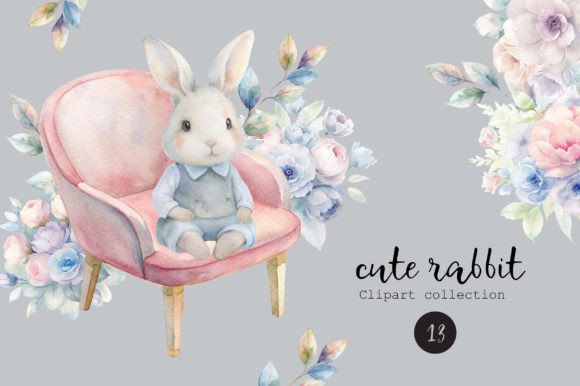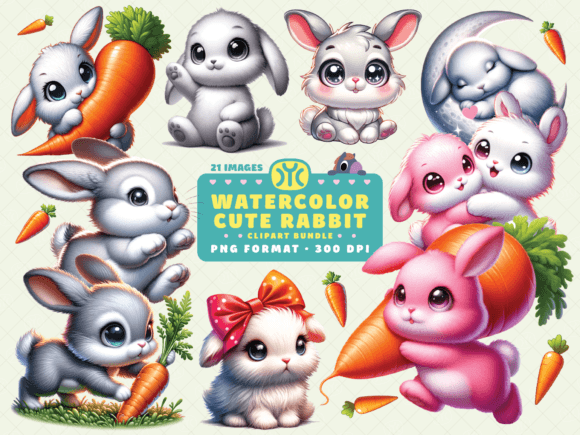
Watercolor Cute Rabbit Clipart
Sterile vector icons and generic stock photography have their place in a designer’s toolkit, but sometimes a project needs a pulse. That’s where a carefully crafted watercolor set, like the Watercolor Cute Rabbit Clipart collection, steps in. It trades rigid precision for something far more valuable in certain contexts: genuine artistic warmth. If you’ve been relying on the same flat illustration packs, shifting to a watercolor aesthetic can fundamentally change how your audience feels about your content.
This isn’t just about slapping a cute bunny on a page. It’s about leveraging the texture, opacity, and organic flow of watercolor pigments to build a visual identity that feels bespoke, gentle, and deeply human. Whether you’re a small business owner building a brand from scratch or a seasoned designer looking for fresh design assets, understanding the strengths of this clipart style can save you hours and elevate your final output.
Beyond “Cute” – Defining the Visual Personality
The Watercolor Cute Rabbit Clipart set thrives on the inherent unpredictability of its medium. Unlike hard-edged vector graphics, these illustrations capture soft blurs, subtle pigment pooling, and the delicate grain of paper peeking through the brush strokes. The result is a display clipart style that feels tactile and approachable rather than manufactured.
The personality of this particular type of asset is defined by three main characteristics:
- Softness and Vulnerability: The rabbits are rarely rigid or perfectly symmetrical. Their ears might flop at slightly uneven angles, and their fur bleeds gently into the background. This communicates a lack of aggression or corporate sterility, making it ideal for audiences seeking comfort or nostalgia.
- Handcrafted Authenticity: In an era of AI-generated imagery, the visible human touch in watercolor is a differentiator. Customers and viewers often subconsciously trust products that look like they were made by a person. This clipart acts as a visual shortcut for “artisanal,” “thoughtful,” and “unique.”
- Whimsical Simplicity: These illustrations don’t try to be photorealistic. They rely on simplified forms and expressive color blends. This makes them highly scalable for web design and social media graphics because they don’t get muddy or confusing when resized.
Strategic Applications Across Projects
Knowing where to deploy this asset is just as important as having it. I’ve seen designers try to force a watercut bunny into a high-tech fintech interface—it doesn’t work. But for projects centered on emotion, nurture, or nature, it is a powerhouse.
Children’s Publishing and Editorial Design
This is the most intuitive use case. In editorial design for parenting magazines or children’s e-books, the Watercolor Cute Rabbit Clipart can anchor a layout without overwhelming the text. It softens the page, making it less intimidating for early readers or parents skimming for gentle content. Pair it with a clean serif font for a classic storybook feel, or a handwritten font for a playful DIY vibe.
Brand Identity for Natural and Organic Products
If you are working on packaging design for a diaper cream, organic baby food, or a natural fiber clothing line, sterile vectors can feel hypocritical. A watercolor rabbit immediately signals “natural” and “non-toxic.” I recently consulted on a rebrand for a small organic soap maker. They swapped their stock vector bunny for a watercolor variant, and their click-through rate on product pages increased measurably. The texture simply looks better on kraft paper and matte labels. It elevates the entire brand identity from commodity to artisan.
Social Media and Digital Content Creation
Marketers and content creators often struggle with visual fatigue. Using the same stock photos makes a feed feel repetitive. The Watercolor Cute Rabbit Clipart set can break that pattern. Use individual PNG files as:
- Email opt-in lead magnets (e.g., a coloring page or wallpaper).
- Quote cards for Instagram or Pinterest featuring a soft background.
- Blog post featured images for topics like gentle parenting, pet loss, or spring crafts.
The organic edges and transparency of watercolor lend themselves beautifully to layered digital compositions.
Practical Guidance: Evaluating the Asset
Not all clipart is created equal. When you look at a pack labeled Watercolor Cute Rabbit Clipart, you need to evaluate it with the same scrutiny you would a premium typeface. Here are the three technical aspects I always check before purchasing a set.
Resolution and Scaling Considerations
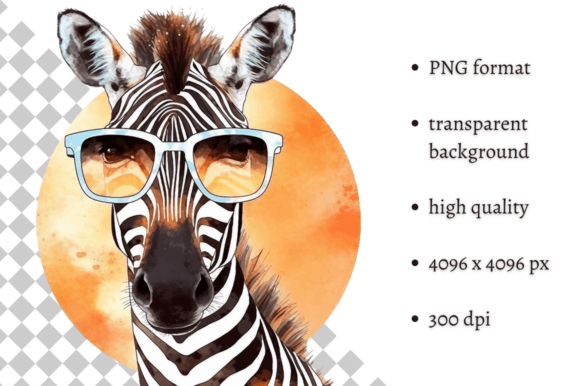
Watercolor textures are beautiful, but they are prone to pixelation if scanned at low resolution. Before you commit, verify the DPI. For any print project (flyers, invitations, packaging design), you want at least 300 DPI. For digital use, 72 DPI is workable, but having a high-resolution source file gives you flexibility. Can the rabbit be blown up to cover half a page without losing the delicate texture? If the set offers vector versions (EPS or AI), that is a huge bonus, allowing infinite scaling without degradation.
File Formats and Layers
The best commercial clipart sets offer individual design assets with transparent backgrounds (PNG). This is non-negotiable for professional work. You do not want a white box around your rabbit’s ears when you place it over a colored background in Photoshop or Canva. Check if the set includes isolated elements (just the rabbit, just a flower) versus full scenes. Isolated elements give you maximum flexibility for logo design variations or custom layouts.
Commercial Licensing and Usage Rights
This is where entrepreneurs and designers often get burned. The commercial license attached to a clipart set defines what you can legally do with it. Read the fine print carefully.
- Personal Use: Usually allows for scrapbooking, gift making, or non-monetized projects.
- Commercial Use: Allows you to use the clipart in products you sell, like e-books, templates, or branding packages.
- Print-on-Demand (POD): This is a tricky one. Some licenses restrict the use of clipart on POD sites like Redbubble or Merch by Amazon. If you plan to sell t-shirts or mugs, ensure the license explicitly covers POD.
I always recommend buying from a vendor that clearly lists the license duration and scope. A commercial font or clipart set is an investment in your business’s brand consistency and professional appearance; skimping on the license can lead to legal headaches or having to remove products from your store later.
Matching the Style to Your Audience
The true power of the Watercolor Cute Rabbit Clipart lies in its ability to foster audience engagement. Who specifically responds to this visual language? Based on my experience:
- New Parents and Expecting Mothers: They are seeking content that mirrors their emotional state—gentle, nurturing, and slightly whimsical. A harsh, photorealistic stock photo of a rabbit might not resonate, but a soft watercolor version feels safe.
- Educators and Therapists: For classroom materials or therapy worksheets, a cute rabbit adds a layer of friendliness that reduces anxiety. A watercolor style feels less clinical than a standard clipart icon.
- Lifestyle Bloggers and Influencers: In the lifestyle space, brand perception is everything. Using a cohesive art style across a blog, Pinterest, and Instagram signals polish and attention to detail. It builds professionalism and recognition.
When pairing this asset with typography, lean into the contrast. A geometric sans serif font (like Montserrat or Proxima Nova) creates a beautiful tension between the organic illustration and modern, clean text. This works well for modern logo design or web design headers. If you want a fully cohesive, dreamy look, pair it with a light script font or a hand-lettered style. Avoid thick, blocky fonts (like heavy slab serifs) as they will crush the delicate watercolor texture.
A Practical Shortcut to Emotional Connection
In the rush to meet deadlines and optimize for conversions, it is easy to overlook the power of a single, beautiful image. The Watercolor Cute Rabbit Clipart set is more than a collection of cute bunnies. It is a strategic shortcut to emotional connection. It saves you the cost of hiring a custom illustrator while providing a high-quality, cohesive visual language that can be applied across editorial design, social media, packaging, and branding.
The next time you are evaluating modern typography or design assets for a project that needs to feel comforting and human, consider this medium. Look for high resolution, flexible files, and clear licensing. When used intentionally, a simple watercolor rabbit can speak louder than a hundred stock photos.